
Spending & Bonds
This page reviews Northwest ISD’s recent bond programs and major spending decisions to assess their long-term taxpayer impact and whether costs, planning assumptions, and outcomes are aligned.
Spending
Davis High School: $475.1M for 730,000 sq ft (≈ $651 per sq ft)
Northwest ISD’s Davis High School (also referred to as “High School #4”) is planned as a 730,000-square-foot campus designed for approximately 3,200 students.
Based on the District’s public-record cost figure of $475,104,132 (obtained via a Texas Public Information Act request), that implies an all-in cost of approximately:
~$651 per square foot ($475,104,132 ÷ 730,000)
~$148,470 per student capacity ($475,104,132 ÷ 3,200)
Note: This “all-in” figure may include more than just the main building shell (e.g., sitework, athletic components, specialty spaces, and other scope items). Even with that caveat, the implied cost level is far above common planning benchmarks used for high school construction.
How that cost compares to typical cost benchmarks
For context, RSMeans’ model-page estimate for a “School, High” building shows total building costs in the neighborhood of roughly ~$187–$208 per square foot (model assumptions vary).
A Texas Association of School Business Officials (TASBO) report using Gordian/RSMeans data (Q3 2025) shows Texas “High” square-foot costs around the low $200s per square foot in several major cities (planning-level model, not a detailed estimate).
Using those planning benchmarks as a reference point, the Davis High School all-in implied cost (~$651/sf) is multiple times higher than typical “model” planning costs. That doesn’t automatically prove waste (scope can differ), but it does support a straightforward question taxpayers should expect answered clearly:
What specific scope elements, site conditions, and procurement choices explain a total implied cost per square foot at this level, and how does the District benchmark that against peer projects?
National comparison: among the costliest public high-school projects reported
Public reporting has documented a handful of extremely high-cost school projects nationally. For example, Los Angeles’ Roybal Learning Center was widely reported at $578 million and described as among the most expensive public school projects.
Against that landscape, a $475M high school campus is not just “expensive”—it appears to sit in the top tier of the largest, costliest public high school builds reported in the U.S.
Why this page highlights one project out of the 2023 bond program
Northwest ISD’s 2023 bond program includes multiple campus projects and additions. This page focuses on one project—Davis High School—because it is large enough to serve as a clear, concrete case study for cost transparency. The intent is not to imply every bond-funded project is identical, but to demonstrate why taxpayers should expect clear, comparable, consistently reported cost metrics across all 2023 bond projects: total project cost, included scope, cost per square foot, cost per student capacity, change orders, and final vs. initial budget.
Proposition A: narrow approval, major promises, structural limits
In November 2025, voters in Northwest Independent School District approved Proposition A, a Voter-Approved Tax Rate Election (VATRE), by a relatively narrow margin. Public discussion surrounding the proposition emphasized the need for additional operational funding, particularly to hire more teachers and address student-to-teacher ratios.
District materials indicated that approximately $8 million of the estimated $12 million annual tax increase would be directed toward hiring additional teachers and instructional staff, with the stated goal of improving classroom conditions and managing growth.
The close vote margin itself reflects that Proposition A was contentious, and that voters expected clear, measurable outcomes in exchange for the higher tax burden.
Why the hiring math does not support the promise
Using publicly available compensation data, an average fully loaded teacher cost of approximately $65,000 per teacher(salary only; benefits would increase the total cost), an $8 million allocation would support roughly:
~120 teachers ($8,000,000 ÷ $65,000 ≈ 123)
Even under optimistic assumptions, this scale of hiring must be evaluated against ongoing enrollment growth, not static enrollment.
Texas Education Agency enrollment data show Northwest ISD has experienced sustained annual student growth in the ~4–5% range in recent years. At that rate, the district adds thousands of new students over a multi-year period, which materially offsets incremental teacher hiring.
Student-to-teacher ratios are unlikely to materially improve
When teacher hiring is analyzed alongside enrollment growth, the net effect is limited. Even with ~120 additional teachers, the district’s overall student-to-teacher ratio remains approximately 15:1, based on TEA staffing and enrollment datasets.
In other words:
New teachers primarily absorb growth
They do not materially reduce ratios
The structural conditions voters were led to expect—smaller class sizes district-wide—are unlikely to occur under current growth trends
This does not mean hiring teachers is unnecessary; it means the scale of the promise exceeded what the funding could realistically deliver.
Why this matters for accountability
Voters were asked to approve a permanent tax increase based on representations that emphasized staffing improvements and classroom relief. A reasonable taxpayer expectation is that:
Promised outcomes are numerically plausible
Growth assumptions are explicit
Success metrics are clearly defined and reported
Without transparent reporting that reconciles teacher hiring, enrollment growth, and resulting ratios, it is difficult for the public to evaluate whether Proposition A is delivering what was implied during the campaign.
This gap between messaging and measurable outcomes is why Proposition A deserves post-approval scrutiny—not to relitigate the vote, but to ensure future tax proposals are grounded in clear, realistic planning.
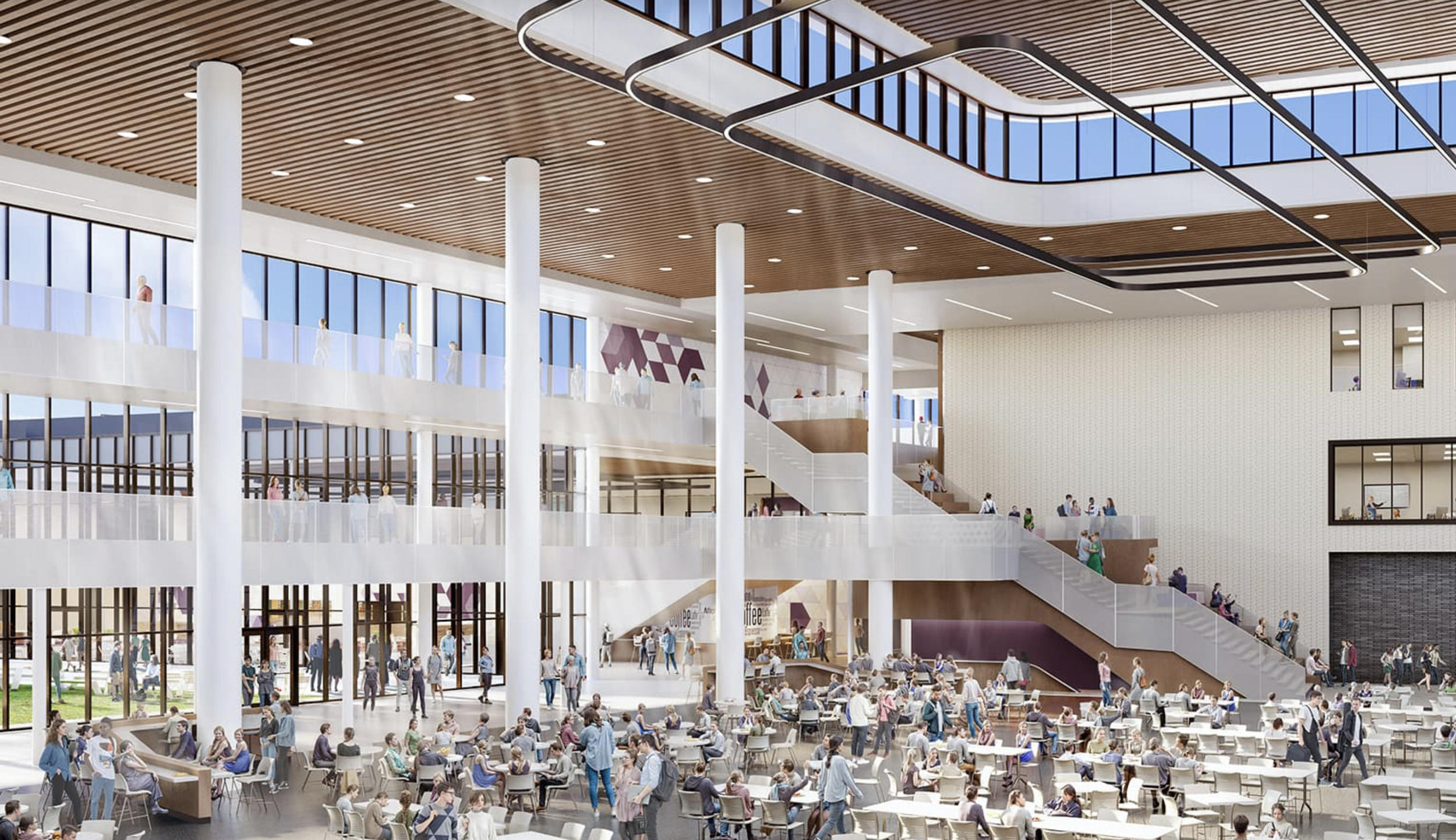
Shown is the cafeteria for the new Davis High School.
Bonds (2023 Bond Program)
$1.995 billion authorized to build 12 new schools (plus other facilities)
In May 2023, Northwest ISD voters approved all three propositions in the District’s bond election. NISD states the approval “will fund $1.995 billion worth of projects” and describes it as a “historic package” that will construct 12 new schools and additional facilities.
NISD’s bond information materials also describe the 2023 bond program as designed to add capacity for approximately 8,400 additional students over time.
Student growth context: ~5% annual growth in recent years (TEA-reported counts)
Northwest ISD has experienced sustained enrollment growth. A Texas Education Agency dataset for the Fast Growth Allotment (HB 1525) shows Northwest ISD growing from 24,141 to 30,736 students over the referenced period—an average growth rate of roughly ~5% per year (annualized).
Separately, NISD’s own planning documents cite ongoing growth expectations in the 4–5% annual range and include multi-year enrollment forecasts.
Why this matters: sustained growth is not “unexpected.” The accountability question for taxpayers is whether long-range planning and phasing could have reduced the need for a single, nearly $2B bond authorization—and whether each major facility is being delivered at cost levels consistent with peer districts and planning benchmarks.
Scope: Davis High School is one project within the broader 2023 bond program
The 2023 bond program includes a new comprehensive high school (Davis High School / “High School #4”) along with other new campuses and facilities. NISD’s bond communications describe the package as including a new high school and multiple other new schools.
This website highlights Davis High School as a case study because it is large enough to make cost transparency questions concrete. The goal is not to claim every project is identical, but to encourage consistent “all-in” reporting across all bond projects (total cost, included scope, cost per square foot, cost per seat, and change orders).
What “$1.995B bond authorization” means (and why total taxpayer cost can be much higher)
A bond authorization is the amount the District is authorized to borrow over time; bonds may be sold in multiple series as projects proceed.
Importantly, the total taxpayer cost of a bond program is not just the principal amount authorized—it also includes interest over the life of the bonds.
Illustrative estimate (not NISD-specific debt service):
If $1.995B were financed over 20–25 years at typical municipal interest rates (for illustration, ~4% to ~6%), total payments could be roughly $3.0B to $3.9B over the payoff period (principal + interest). (This is a modeling range; actual costs depend on the timing of bond sales, market rates at issuance, maturities, and any refinancing.)
NISD Forward request: “all-in cost after payoff”
NISD Forward has requested the District’s total “all-in” cost for the 2023 bond program (principal + interest over the payoff period). As of this posting, the District has not yet provided that complete, consolidated figure.

Why it matters
Taken together, the 2023 bond program, the Davis High School project, and Proposition A illustrate a consistent pattern: major financial commitments are being made faster than outcomes or capacity planning justify. Voters approved a nearly $2.0 billion bond package to build 12 schools—including a **$475 million, 730,000-square-foot high school with an implied cost far above common benchmarks—**even though enrollment growth has been steady and foreseeable at roughly ~5% annually, not a sudden surge. Separately, Proposition A passed narrowly after emphasizing teacher hiring and improved student-teacher ratios, yet the math shows that even allocating $8 million to staffing yields roughly ~120 teachers, which largely absorbs growth rather than materially reducing ratios district-wide. The result is higher long-term tax obligations—potentially billions more after interest over 20–25 years—without clear, measurable improvements in classroom conditions or academic results. This matters because school finance decisions lock in costs for decades; when planning assumptions, cost transparency, and outcome metrics are misaligned, taxpayers bear permanent obligations while promised benefits remain elusive.
Sources - Spending
Northwest ISD Construction Website – High School #4 (Davis High School)
Project details including 730,000 sq ft and ~3,200 student capacity.
https://www.nisdtxconstruction.org/high-school-4-1RSMeans – High School Model Page (Planning-Level Cost per Sq Ft)
Industry-standard planning benchmarks for high school construction costs.
https://www.rsmeans.com/model-pages/high-schoolTexas Association of School Business Officials (TASBO) – 2025 Report: School Construction Costs in Texas
Provides Texas cost context using Gordian / RSMeans data.
https://www.tasbo.org/resources/2025-report-school-construction-costs-in-texasTASBO – Gordian Data for TASBO (PDF)
Detailed square-foot cost data used for school construction benchmarking.
https://www.tasbo.org/uploads/files/general/2025-Gordian-Data-for-TASBO.pdfABC News – Roybal Learning Center ($578M)
National reporting describing one of the most expensive public school projects in U.S. history.
https://abcnews.go.com/WN/public-school-los-angeles-named-robert-kennedy-expensive/story?id=11462095NBC Los Angeles – Roybal Learning Center Cost Coverage
Additional reporting on the $578M project and its national context.
https://www.nbclosangeles.com/news/local/grading-the-nations-most-expensive-school/1882026/LAist – Roybal Learning Center Construction History
Background on the project and its unprecedented cost.
https://laist.com/news/the-most-expensive-high-school-in-l-aCT Insider – Wallingford, CT Consolidated High School (~$411.6M)
Example of another rare $400M+ high school project nationally.
https://www.ctinsider.com/recordjournal/article/ct-wallingford-one-high-school-sheehan-lyman-hall-20825428.phpMidland Reporter-Telegram – Midland ISD High School Project (~$420M)
Texas example illustrating upper-range high school project costs.
https://www.mrt.com/news/article/midland-legacy-high-school-groundbreaking-20394348.phpNorthwest ISD – Texas Public Information Act Response (Primary Source)
District response stating Davis High School total project cost: $475,104,132.
https://1drv.ms/b/c/f6135635de302183/IQA7_m-mRwv_QYB2DJxx8NBXAcH34ULOGEDhYYpI71dmnCw?e=v6DaZeNorthwest ISD – Proposition A / VATRE election materials and results
District communications describing Proposition A purpose, projected revenue, and staffing emphasis.
https://www.nisdtx.orgTexas Education Agency (TEA) – Enrollment and Staffing Data (PEIMS)
District-reported student enrollment and teacher counts used to evaluate student-to-teacher ratios.
https://tea.texas.gov/finance-and-grants/state-funding/state-funding-reports-and-dataTEA – District Fast Growth / Enrollment Trend Data
Shows sustained enrollment growth used to contextualize staffing additions.
https://tea.texas.gov/finance-and-grants/state-funding/state-funding-reports-and-data/hb1525-districts-eligible-for-fast-growth-allotment-for-2024-2025.pdfNorthwest ISD – Teacher Compensation Schedules
Used to estimate average per-teacher cost for staffing projections.
https://www.nisdtx.org/departments/human-resources/compensation
Sources - Bonds
NISD Newsroom (May 6, 2023): voters approved all propositions; “$1.995 billion”; “historic package”; “construct 12 new schools.”
https://www.nisdtx.org/news-events/newsroom/details/~board/homepage-news/post/2023bondresultsNISD Newsroom (Feb 13, 2023): bond election called; would build 12 new schools and additional facilities.
https://www.nisdtx.org/news-events/newsroom/details/~board/homepage-news/post/bond-election-called-to-build-schools-facilities-to-meet-record-setting-growthNISD Bond site: overview / growth framing; describes $1.9B bond and capacity for 8,400 additional students.
https://www.nisdtxbond.org/NISD Newsroom (Apr 29, 2025): progress on bond projects “making room for 8,400 students.”
https://www.nisdtx.org/news-events/newsroom/feature-stories/progress-on-bond-projects-making-room-for-8400-studentsNISD Bond site: bond proposal page explaining what a bond authorization is and that bonds may be sold over time.
https://www.nisdtxbond.org/bond-proposalTEA Fast Growth Allotment list (HB 1525) showing Northwest ISD counts (24,141 → 30,736) used here to compute ~5% annualized growth.
https://tea.texas.gov/finance-and-grants/state-funding/state-funding-reports-and-data/hb1525-districts-eligible-for-fast-growth-allotment-for-2024-2025.pdfNISD District Improvement Plan (planning document citing demographer expectation of 4–5% annual growth; includes forecast table).
https://resources.finalsite.net/images/v1695753532/nisdtxorg/tdptqxondmvzzcjaimiv/2023-2024NorthwestISDDistrictImprovementPlan-Approved92523.pdfFOX 4 coverage of the bond passing and what Prop A included (new schools, including a high school).
https://www.fox4news.com/news/northwest-isds-nearly-2b-bond-package-passesCross Timbers Gazette summary of bond scope (new high school + other schools/facilities), citing district release.
https://www.crosstimbersgazette.com/2023/02/14/northwest-isd-calls-2b-bond-election-to-build-12-new-schools-more/